
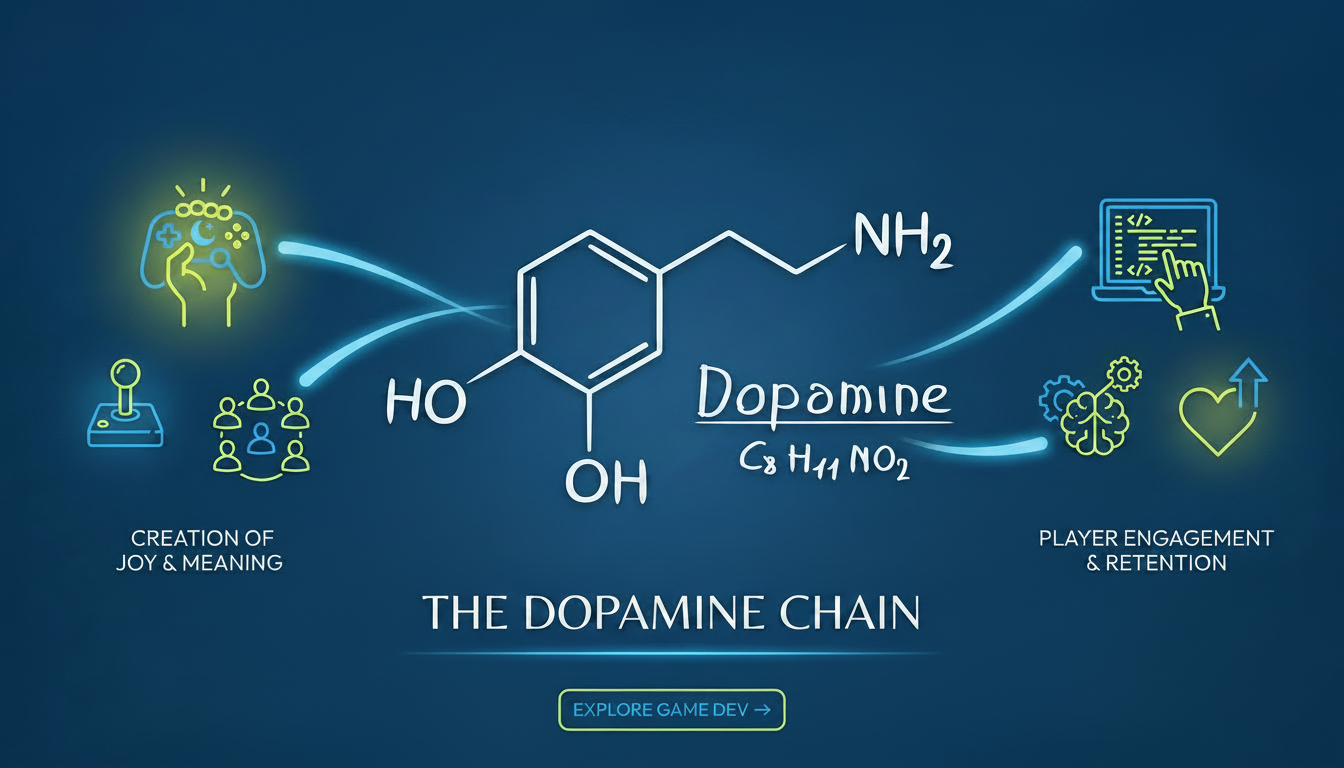
We talk about dopamine like it belongs to the player. The finished level. The match was won. The name is climbing the leaderboard. All of it real. But the dopamine starts long before anyone downloads the game. It starts with the person who imagined it.
It starts with an idea.
You have an idea. A mechanic, a character, a way to solve a design problem you have been stuck on for weeks. You build the first prototype. You press Play. Something moves. The thing that lived only in your head suddenly becomes interactive and answers back.
That moment has its own reward, and it does not belong to the founder alone. The designer feels it when the loop finally clicks. The artist feels it when the character reads right on a small screen. Development runs its own loop. Imagine, build, test, improve, watch it work. We are playing our own game while we make it. Then we hand it over. The game was never made for us.
Eventually, it goes into someone else’s hands. Now, a second loop begins, the player’s. Discover, play, learn, improve, achieve, come back. A designer spends two weeks balancing one difficulty curve. A developer spends three days making a single tap feel responsive. Somewhere in the world, a player lives through all of it in half a second, makes the move, wins, and smiles.
That is where our work becomes their feeling. The part we cannot ignore. This is where understanding player psychology gets serious. Reward loops are powerful. Progression, daily rewards, competition, collection, the quiet pull of one more turn. Every one of them shapes behavior.
So the question a studio asks itself matters more than any of them. “How do we make players play more?” is the easy question. It pays the bills, and it can cost you the player. The one I hold to is harder. “How do we make the time they spend worth playing?” A game can demand attention.
A good game earns it back.
With challenge, mastery, a laugh, a match with friends, something the player is glad they gave their evening to. That is the line I hold Maysalward to. The loop comes back to you. Then the strange part. The chain becomes a loop. You ship it. A player you will never meet picks it up. And their reaction travels back to you. A review. A message.
A video of someone playing on a bus.
A tournament between friends. Someone who tells you they have played your game for years. One of them found us on a Nokia, back when a game had to squeeze onto a feature phone. That was more than 22 years ago. He is still playing today, on a phone that did not exist when he first pressed Play. The device kept changing. He stayed.
That reward does not come from finishing the code or hitting launch day. It comes from knowing that someone, somewhere, enjoyed what a room full of people built. Why do we do it again?
We start with nothing but an idea.
People come together and build it. We press a button and send it into the world. Someone plays, faces a challenge, makes a move, and for a second, smiles. We enjoy making the game. They enjoy playing it. Their enjoyment is why we start again.