
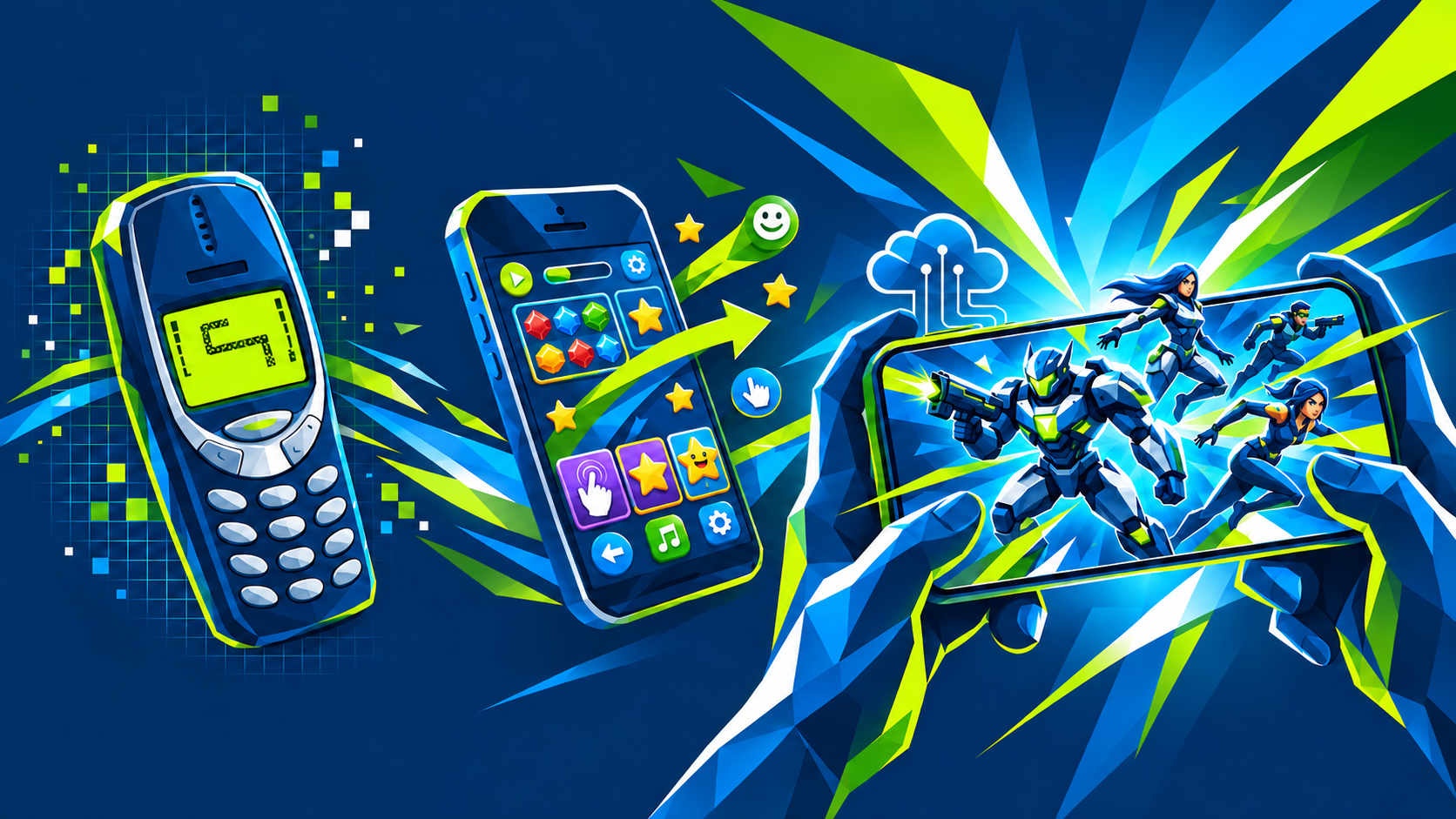
In 1997, if you wanted to play a video game on your phone, you stared at a tiny, monochrome green-and-black LCD screen, pressed the “2,” “4,” “6,” and “8” keys on a rubber T9 keypad, and guided a pixelated line toward a blinking dot.
Fast forward to today. That same pocket-sized device now has a 120Hz OLED display, hardware-accelerated ray tracing, and enough processing power to run sprawling open-world RPGs, fill global esports arenas, and stream console-exclusive titles from the cloud over 5G.
The evolution of mobile gaming is arguably the most dramatic transformation in the history of interactive entertainment. In less than three decades, mobile games went from pre-installed novelties meant to kill five minutes at a bus stop to the largest, most lucrative sector of the entire gaming industry, generating more revenue than PC and console gaming combined.
For everyday gamers, indie developers, and tech enthusiasts, understanding how we got here is more than a trip down memory lane. It is a masterclass in how hardware, distribution, business models, and connectivity collide to rewrite an industry. Let’s trace the four distinct eras that turned our phones into the world’s favorite gaming platform.
Era 1: The Feature Phone Days (Keypads, Monochrome Screens, and J2ME)
Before “apps” existed, mobile gaming was defined by extreme constraints. When Nokia pre-installed Snake on the Nokia 6110 in 1997, and later cemented its legendary status on the indestructible Nokia 3310, it accidentally proved a massive thesis: people want to play games everywhere.
As feature phones evolved in the early 2000s, monochrome screens gave way to tiny color displays and J2ME (Java 2 Platform, Micro Edition). Suddenly, publishers like Gameloft and EA Mobile were porting scaled-down versions of Tetris, Prince of Persia, and Asphalt to flip phones and candybar handsets.
The Developer’s Nightmare (and Creative Triumph)
From a development standpoint, the feature phone era was brutal:
- Fragmentation: Developers had to manually port a single game to hundreds of different handset models, each with its own screen resolution, keypad layout, and microscopic memory limits (often under 100 kilobytes).
- Carrier Gatekeeping: There was no centralized store. To get a game onto a phone, studios had to negotiate directly with telecom carriers to be listed on clunky “WAP portals,” where players paid $3 to $5 via SMS for a single download.
Yet those constraints forced brilliant, minimalist game design. Because you only had a thumb and a number pad, games had to be instantly understandable, endlessly replayable, and stripped of all bloat. That design philosophy still underpins the best casual mobile games today.
Era 2: The Touchscreen Revolution and the App Store Boom
Everything changed in 2007 and 2008. When Apple launched the original iPhone, followed closely by the App Store and Android Market (now Google Play) in 2008, two massive walls collapsed overnight: physical buttons disappeared, and telecom carriers lost their stranglehold on distribution.
For the first time in history, a two-person indie team in a garage could publish a game directly to millions of players worldwide, keeping 70% of the revenue.
Native Mobile Mechanics Are Born
Early smartphone games tried to mimic console controllers with clunky on-screen D-pads, and most failed. The true breakthrough came when developers embraced what made smartphones unique: capacitive multi-touch screens and built-in accelerometers.
- Angry Birds (2009) turned the touchscreen into a tactile slingshot.
- Doodle Jump (2009) used tilt controls to make the phone itself the controller.
- Fruit Ninja (2010) and Temple Run (2011) invented swipe-based reflexes that felt impossible on a traditional gamepad.
The Indie Gold Rush: This era was the golden age of the $0.99 premium mobile game. Development costs were low, discoverability was high, and a clever, polished physics puzzle or endless runner could turn a tiny indie studio into a global media franchise overnight.
Era 3: The Free-to-Play (F2P) Shift and Live-Service Economics
By 2012, the App Store was flooded with hundreds of thousands of games, and a harsh economic reality set in: convincing a casual user to pay even $0.99 upfront for an unknown game was getting harder and harder.
The industry’s answer permanently rewired gaming economics: Free-to-Play (F2P).
Pioneered by juggernauts like King’s Candy Crush Saga (2012) and Supercell’s Clash of Clans (2012), the F2P model removed the upfront price tag entirely. Anyone could download and play for free, while revenue came from optional in-app purchases (IAPs) such as extra lives, cosmetic skins, time-savers, and resource bundles, alongside rewarded video ads.
From “Products” to “Live Services”
This business shift changed how mobile games were designed and operated:
- Games as a Service (GaaS): Studios stopped shipping a finished game and moving on. Instead, they built “live-ops” teams to run weekly events, clan wars, seasonal battle passes, and daily login rewards designed to keep players engaged for years.
- Data-Driven Design: Developers began using real-time analytics to track exactly which level made players quit, tweaking difficulty curves on the fly.
F2P unlocked billions of dollars in revenue and made gaming accessible to anyone with a smartphone. It also had a dark side. Aggressive monetization, loot boxes, and “pay-to-win” mechanics sparked widespread player fatigue, creating a rift between “core” gamers and mobile gamers that took nearly a decade to heal.
Era 4: Modern Mobile (Console Parity, Cross-Play, Esports, and Cloud Gaming)
If the 2010s were about proving mobile gaming was profitable, the 2020s are about proving mobile gaming is limitless.
Driven by leaps in mobile silicon, like Apple’s A-series and M-series chips and Qualcomm’s Snapdragon flagship processors, the performance gap between a smartphone and a dedicated gaming console has shrunk dramatically. Today, three major trends define the modern mobile landscape:
1. Cross-Play and Cross-Progression
The wall between “mobile gamers” and “PC/console gamers” has crumbled. Titles like Genshin Impact, Fortnite, Call of Duty: Mobile, and Diablo Immortal deliver full-scale, console-grade experiences on a phone. With cross-progression, you can grind a dungeon on your PC at night and pick up your exact save file on your smartphone during your morning commute.
2. The Rise of Global Mobile Esports
In regions like Southeast Asia, Latin America, and South Asia, smartphones are not a secondary gaming device. They are the primary gaming device. As a result, mobile esports has exploded into a global phenomenon.
Games like PUBG Mobile, Mobile Legends: Bang Bang, Free Fire, and Brawl Stars regularly draw millions of concurrent viewers, offer multi-million-dollar prize pools, and sell out stadiums worldwide, often rivaling or surpassing traditional PC esports in viewership.
3. Cloud Gaming and 5G
Perhaps the most disruptive shift of all is cloud gaming. Powered by high-speed 5G and Wi-Fi 6, platforms like Xbox Cloud Gaming and NVIDIA GeForce NOW let players stream massive AAA console and PC titles directly to their smartphones.
By offloading the heavy graphical rendering to remote data centers, cloud gaming decouples game quality from local hardware. Pair a budget smartphone with a snap-on telescopic controller, and you effectively have a next-gen handheld console in your pocket.
Conclusion: What Comes Next?
Looking back, the journey from Snake on a Nokia 3310 to stadium-filling mobile esports and cloud-streamed AAA blockbusters is remarkable. Every time the industry hit a ceiling, whether it was keypad controls, carrier gatekeepers, or hardware limits, innovation broke through and expanded what a “mobile game” could be.
And the evolution is far from over. As hardware matures and cloud infrastructure expands, the next seismic shift is already happening behind the scenes, driven by artificial intelligence transforming how games are drawn, coded, and tested.
Whether you are an indie developer building for the next billion players or a gamer who has been playing on phones since the flip-phone days, one thing is certain: the pocket revolution is just getting started. If you want to see where Maysalward fits in this story, browse our mobile games.